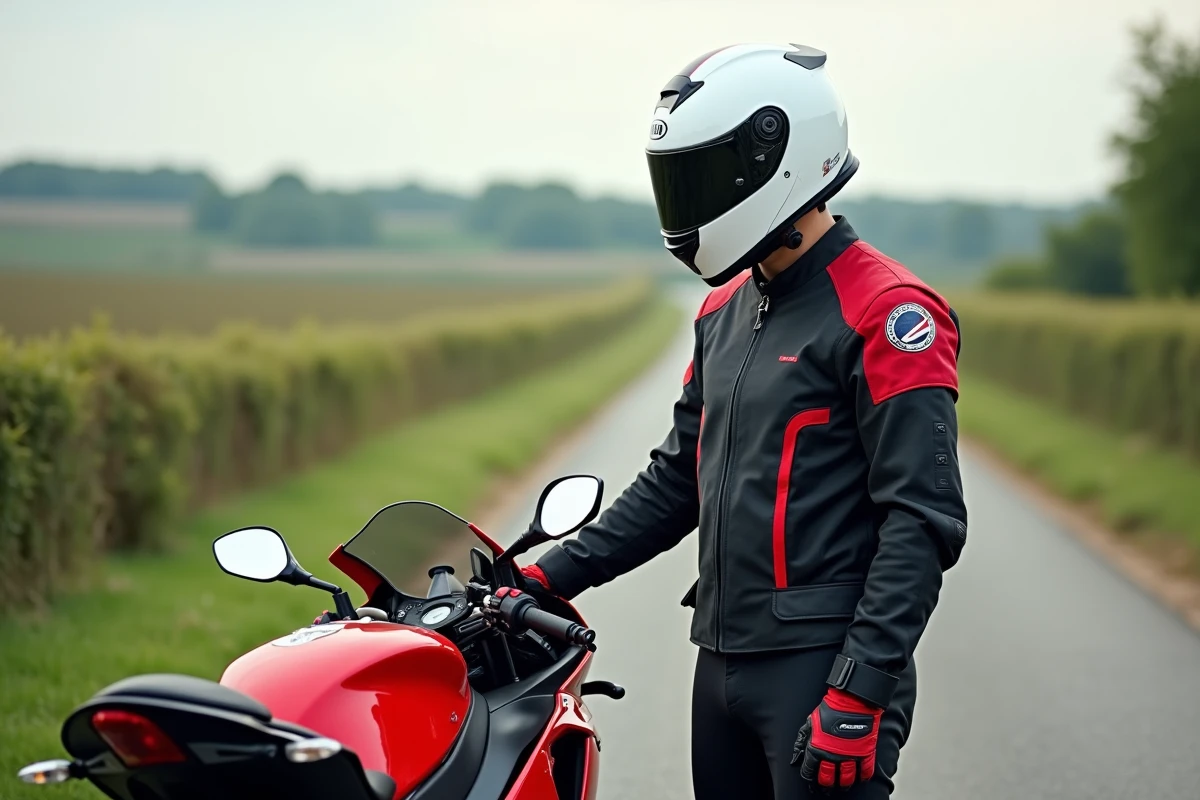
The CBR600RR was never designed for the A2 license. Its inline four-cylinder engine produces power well beyond the 35 kW limit imposed by the A2 category, and above all, its power-to-weight ratio exceeds the regulatory threshold of 0.2 kW/kg for most model years. We regularly observe confusion between “technically restrictable” and “administratively eligible,” two concepts that the registration certificate distinguishes without ambiguity.
Reference P.2 and power-to-weight ratio: what blocks the CBR600RR in A2
The determining criterion is not the mechanical possibility of installing a restriction kit. European regulations impose two cumulative conditions for a motorcycle restricted to 35 kW to be eligible for A2: the original power must not exceed 70 kW (which is double 35 kW), and the power-to-weight ratio in running order must not exceed 0.2 kW/kg.
For CBR600RRs produced between 2003 and 2024, the manufacturer’s declared power at reference P.2 on the registration certificate is well above 70 kW. This single point renders the motorcycle ineligible for A2 restriction, regardless of the kit installed. An intake restrictor or an ECU reprogramming does not change the original P.2 recorded on the registration certificate.
We recommend systematically checking field P.2 before any purchase. A private seller who claims that their CBR600RR “is restrictable to A2” often confuses the old licensing regime (restriction to 25 kW, applied before 2013) with the current regulations. The two legal frameworks are incompatible, and the Honda CBR600RR restrictable to A2 remains a topic where misconceptions circulate faster than official texts.
CBR600RR imported from outside the EU: taxation, Crit’Air, and registration certificate
Importing a used CBR600RR from a country outside the European Union adds several layers of complexity that guides focused on new European models completely ignore.
Customs duties and VAT on imports
A motorcycle imported from a third country is subject to customs duties applicable to motor vehicles, along with French VAT calculated on the customs value increased by the duties. The total amount can represent a significant fraction of the purchase price, which reduces the apparent price advantage of a model bought in Japan or North America.
Individual approval and compliance
A vehicle not approved in the EU must undergo an individual approval (RTI) with the DREAL. This procedure checks compliance with current European standards, including emission thresholds. For an older CBR600RR, homologation to current anti-pollution standards can prove to be a blocking issue.
Crit’Air sticker and traffic restrictions
The Crit’Air sticker assigned depends on the vehicle’s Euro standard, not its calendar age. An imported CBR600RR without a Euro standard recognized in France risks being assigned a Crit’Air sticker 4 or 5, or even no classification at all. In active ZFE-m (low-emission mobility zones) in several French metropolitan areas, this can completely prohibit circulation during the week.
- Check the Euro standard listed on the certificate of origin or customs document before purchase, as reclassification afterwards is nearly impossible.
- Plan for the cost of the RTI, which includes technical inspection fees, any modifications for compliance, and registration taxes.
- Anticipate the impossibility of insuring the motorcycle under A2, since the original P.2 remains above the authorized limit, whether the motorcycle comes from Japan, Thailand, or the United States.
Insurance and registration certificate checks: refusals are multiplying
Since 2024, several major insurers have strengthened their verification procedures for sports motorcycles declared in the A2 category. Cross-referencing the P.2 and Q references on the registration certificate has become systematic at certain companies.
A P.2 exceeding 70 kW results in an automatic refusal of A2 coverage, even if a restriction kit is physically installed. The annual report from FFMC published in March 2026 confirms this upward trend in refusals of insurance for non-homologated restricted sports motorcycles.
The problem is not limited to insurance. In the event of a roadside check, riding with an A2 license on a motorcycle whose P.2 exceeds the regulatory limit constitutes driving without a valid license. The consequences go far beyond a simple fine: license suspension, vehicle immobilization, and exclusion from coverage in the event of a claim.
Reliability of restriction kits on CBR600RR in road use
Even setting aside the legal question, the mechanical aspect deserves to be addressed. Feedback from specialized forums indicates premature wear of intake restrictors on CBR600RRs in sustained road use. Failures frequently appear around 10,000 km according to a user survey published in early 2026.
A sporty four-cylinder designed to deliver its power at high revs does not handle prolonged restriction at low revs well. Operating outside the optimal range accelerates fouling, puts more strain on the clutch, and generates unwanted vibrations at revs that the manufacturer did not calibrate for regular use.
Honda alternatives truly eligible for the A2 license
Honda offers several models that are natively A2 compatible, without any tinkering or administrative gray areas. The CB500F, CBR500R, and restricted CB650R cover a wide spectrum, from versatile roadsters to mid-displacement sports bikes.
- The CBR500R offers a sporty riding position with a twin-cylinder engine whose original power remains below the A2 ceiling, without the need for a kit.
- The CB650R, with its inline four-cylinder, can be restricted to 35 kW while remaining compliant with the power-to-weight ratio, as its original power does not exceed 70 kW.
- The NC750S is a more road-oriented option, with a frugal twin-cylinder engine and torque available from low revs, suitable for daily use.
The CBR600RR remains a track and A license motorcycle. No mechanical setup compensates for a P.2 outside the regulatory framework. It is better to direct your budget towards a model whose registration certificate raises no questions for the insurer or the police.