
A hollow door, known as a honeycomb core door, consists of two thin facings (often made of fiberboard) separated by a honeycomb structure made of cardboard. This facing is rarely more than a few millimeters thick. Screwing directly into it is like fixing into cardboard: the screw turns in empty space, the hook holds for a few days, then pulls out under the weight of a coat.
Structure of a honeycomb door: understanding before drilling
Before any fixing, it is essential to identify the exact composition of the door. The peripheral frame (the stiles and rails) is made of solid wood or dense particleboard. This is the only area where a standard screw can grip properly.
The rest of the panel, the central part, offers only a facing of a few millimeters glued onto the cardboard honeycomb. Tapping with a finger on the surface helps to identify solid areas (dull sound) and hollow areas (hollow sound, resonating).
To attach a hook on a hollow door in the central area, a standard screw is insufficient. You must either penetrate the facing with an appropriate fixing device or work around the problem by targeting the frame or using a no-drill solution.
- The peripheral frame (solid wood) accepts standard wood screws, provided you pre-drill to avoid splitting the wood.
- The central honeycomb area requires a specific anchor or internal reinforcement to support repeated loads.
- The intermediate stiles, present on some models, provide an additional anchoring point that can be located by tapping.

Anchors for hollow doors: choosing the right fixing system
The choice of anchor determines the strength of the installation. Three families of fixings work on a thin facing.
Toggle bolt
The toggle bolt passes through the facing and opens behind, distributing the load over a larger surface than just the hole. You drill a sufficient opening to pass the folded toggle, insert the whole assembly, and then tighten. The toggle pivots and presses the facing between the screw head and the internal wings.
This system offers the best hold on a hollow support. Its drawback: the drilled hole is larger than with a standard screw, and disassembly leaves a visible opening.
Molly bolt (expansion anchor)
The Molly bolt works on a similar principle. By tightening the screw, the metal body deforms and creates an anchor behind the facing. It is suitable for thin facings as long as you choose the correct diameter: a Molly that is too long will not be able to deform correctly within the reduced thickness of a honeycomb door.
Checking the thickness of the facing before purchase avoids mistakes. Most packaging indicates a compatible thickness range.
Self-drilling anchor
Faster to install, the self-drilling anchor screws directly into the facing without pre-drilling. It is suitable for light loads (scarves, keys, hats). For a winter coat or a bag, the toggle bolt remains preferable.
No-drill fixing on a hollow door: alternatives and limitations
Drilling a door is not always possible. In rentals, on a fire door or an acoustic door, any modification to the facing can degrade the certified performance of the door unit. No-drill devices then become the only viable option.
Adhesive hooks use double-sided adhesive or mounting tape. Their hold depends on the cleanliness of the surface, ambient temperature, and humidity level. Near a bathroom or in an environment subject to thermal variations, reliability decreases significantly.
Over-the-door hooks hang on the top edge without any fixing. They support moderate loads and can be removed without leaving a trace. Their limitation: they only work on the top edge and slightly alter the door’s closure if the gap between the door and frame is small.
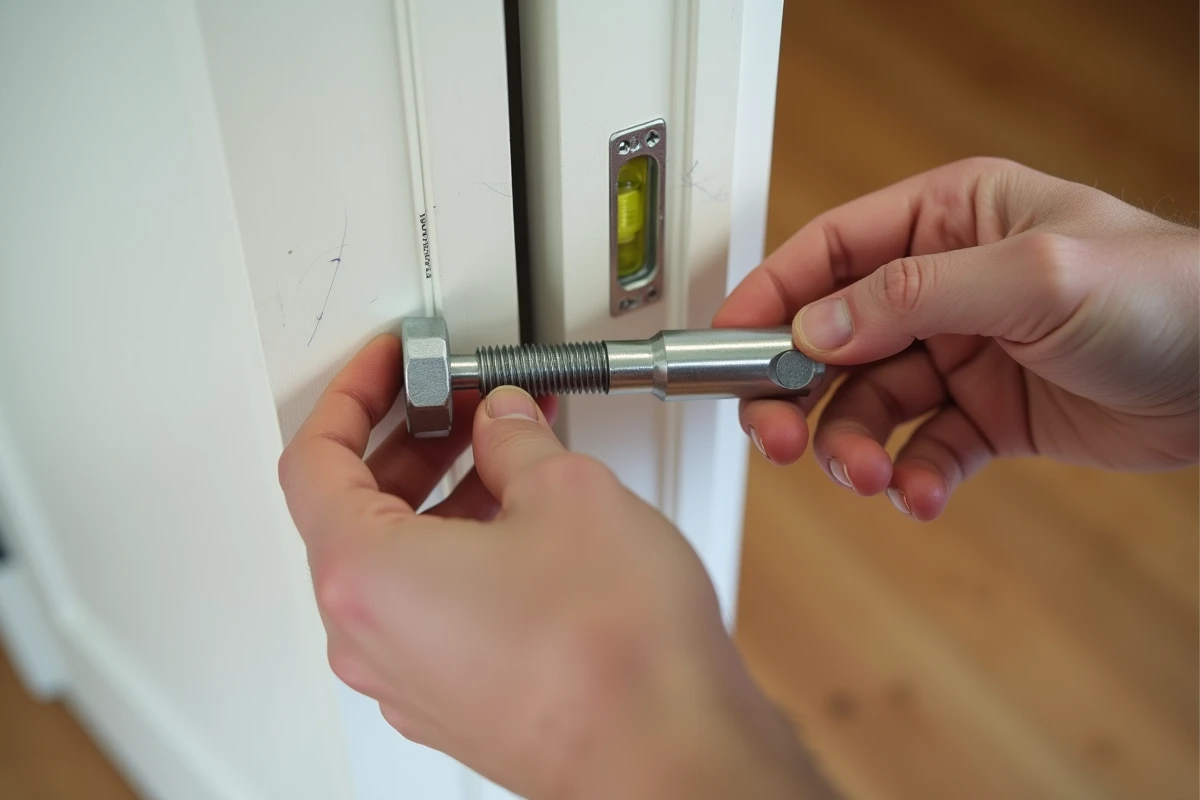
Installing a hook on a hollow door: step-by-step method
Once the type of fixing is chosen, the installation follows a precise order.
- Identify the fixing area by tapping on the door to distinguish between the wooden frame and the honeycomb area, then mark the location with a pencil.
- Pre-drill with a drill bit suitable for the diameter of the chosen anchor, keeping the drill perpendicular to the facing to avoid an oval hole.
- Insert the anchor (toggle or Molly) following the manufacturer’s instructions, then screw in gradually without forcing to avoid crushing the facing.
- Attach the hook plate to the anchor, check the horizontal alignment if multiple fixing points are aligned, and tighten definitively.
A often overlooked point: the dynamic load (a coat being hung and taken down) exerts more stress than a static weight. Pulling on the hook once installed allows you to check that the anchor does not turn in the facing.
Reinforcing the fixing area
On a very thin honeycomb door, gluing a plywood plate inside the hole before inserting the anchor improves load distribution. This technique, common among installers, transforms a fragile fixing point into a solid support. It requires a slightly larger hole to slide in the reinforcement, but the result more than compensates.
Fixing a hook on a hollow door primarily relies on diagnosing the support. Targeting the wooden frame when possible remains the most reliable solution. In the honeycomb area, a properly installed toggle bolt can support the usual uses of an entryway. No-drill solutions remain relevant for light loads or doors that cannot be modified, provided you accept their limitations regarding humidity and repeated stress.