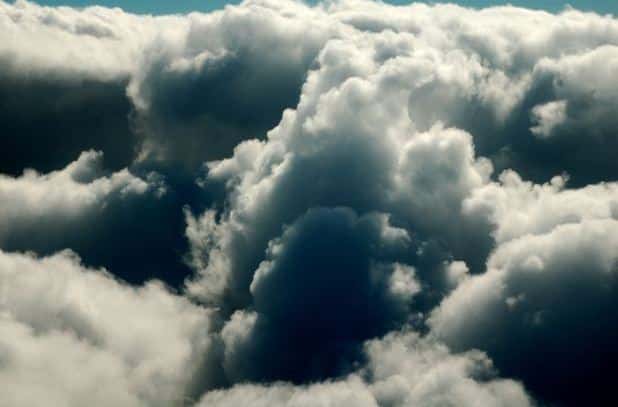
A cloud is a large quantity of water droplets (or ice crystals) suspended in the atmosphere. Clouds are formed by the condensation of water vapor contained in the air. The appearance of a cloud depends on the light it receives, the nature, size, number, and distribution of the particles that compose it. The water droplets in a cloud come from the condensation of water vapor in the air. The maximum amount of water vapor (invisible gas) that can be contained in a mass of air depends on the temperature: the warmer the air, the more water vapor it can hold. They have very varied masses and shapes. We will teach you to recognize the main clouds and their characteristics.
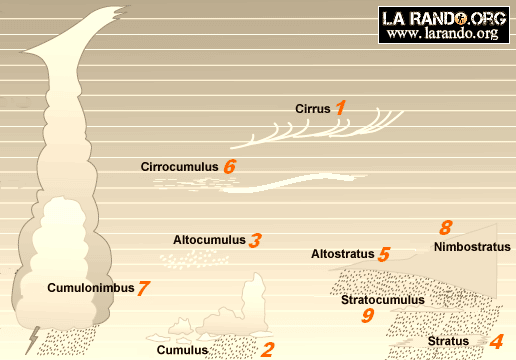
- 1 Cirrus
Clouds made of ice crystals, in the form of a plume, a comma, or a colored white filament. High-altitude clouds between 6000 and 10000 m. Comma-shaped cirrus are often precursors of rain (arrival of a warm front).
- 2 Cumulus
The clouds are separated from each other, often resembling huge horizontal cauliflowers, and changing rapidly in shape and volume. They are located between 1000 and 5000 m above sea level. Their significance varies depending on the circumstances. They can produce a thunderstorm if their vertical development is significant.
- 3 Altocumulus :
Ball-shaped clouds, more or less fused together and in extensive sheets. They give a “ugly” sky. They are between 2500 and 5000 m. Frequently observed during pre-thunderstorm periods.
- 4 Stratus :
Form a dark, uniform, and low layer (from 300 to 1000 m). They produce a little drizzle and, at altitude, fog.
- 5 AltoStratus :
Form a gray or bluish, fibrous, heavy and threatening layer, at mid-altitude (between 3500 and 5000 m). Generally precedes nimbo-stratus.
- 6 Cirro-Cumulus :
Similar to those of large flakes, they form a whitish cloud veil, through which the sun or even the moon appears surrounded by a halo. Altitude generally above 5000 m. Announce the end of good weather.
- 7 Cumulo-Nimbus :
Clouds with a gigantic vertical extension. They can measure over 9000 m in height, with the base between 1000 and 2000 m altitude. They bring heavy rain in the form of showers, sometimes fearsome thunderstorms, and in some cases hail.
- 8 Nimbo-Stratus :
They give a gray and dark sky, “overcast.” Usually, they are located between 1000 and 2000 m altitude. They can produce fog in the mountains. They are accompanied by more or less continuous precipitation or snow.
- 9 Strato-cumulus :
Sheets of gray or whitish clouds showing the corners where blue sky is revealed. They do not announce anything specific.
Tag : know the clouds