
Conflicts between parents and adult children rarely follow a linear trajectory. A longitudinal American study published in 2023 in the Journal of Marriage and Family observed that many previously estranged adult children were reconnecting with their parents during a later wave of the survey. This finding raises a concrete question: how can a parent express their love to their adult son without rekindling the tensions that led to the distance?
Parent-adult son disagreement: why each tells a different story
Research on family estrangement reveals a recurring gap between the explanations given by parents and those of their adult children. Children often cite repeated parental behaviors or ignored boundaries. Parents, on their part, may attribute the rupture to external influences or their child’s romantic life.
This gap is not a detail. It structures most reconciliation attempts that fail because each party approaches the conversation with a narrative of the conflict that the other does not recognize. Trying to impose a shared version of the past before clarifying what needs to change in the present often produces the opposite effect of what is hoped for.
For a parent who wants to know how to tell their adult son that they love him, the most productive starting point is to ask what the other expects now, rather than revisiting what happened five or ten years ago.
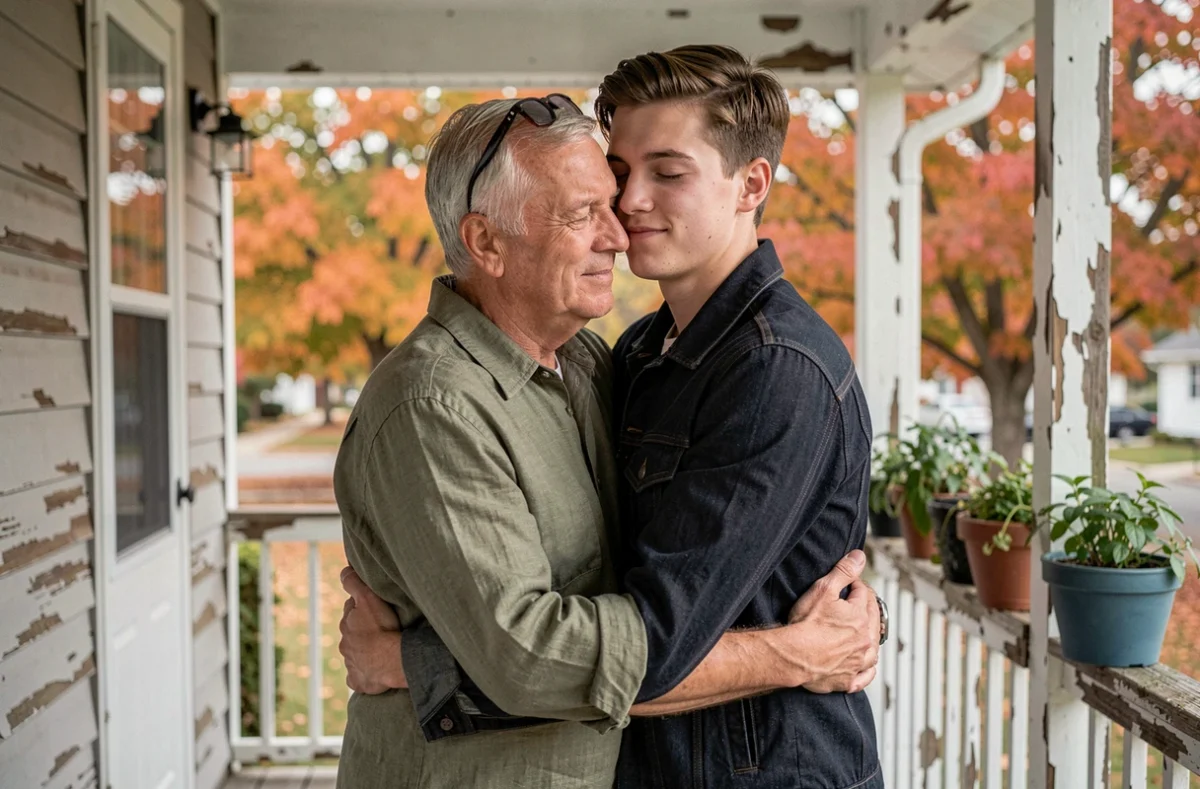
Expressing love without crossing the boundaries set by the son
Parental affection, even when sincere, does not replace respect for boundaries. Qualitative research on family ruptures describes estrangements that sometimes occur after repeated attempts by the adult child to enforce boundaries, which have not been acknowledged. Love expressed without respect for boundaries is perceived as pressure.
Practically, this means that a loving message sent after months of silence can be received very differently depending on whether it respects the framework set by the son. A parent who writes “I miss you, call me whenever you want” leaves the initiative to the other. A parent who writes “I don’t understand why you’re not responding, I love you though” turns a declaration of love into an implicit reproach.
What changes the reception of the message
- Explicitly recognizing the son’s right to set conditions on the frequency and format of exchanges, even if these conditions seem excessive to the parent
- Separating the expression of affection from any immediate request for reciprocity: saying “I love you” without adding “and I expect you to say it back”
- Accepting that reconnecting may be gradual rather than an instant return to the pre-conflict relationship
A gradual reconnection better protects the relationship than a forced reconciliation. The aforementioned longitudinal study shows that reconnections often happen on their own, provided the door remains open without the parent pushing it.
Parent-adult child communication: breaking the authority pattern
The most underestimated difficulty in family conflicts between parents and adult sons lies in the communication style inherited from childhood. A parent who has spent twenty years guiding, correcting, and protecting does not naturally shift to an exchange between equals.
Talking to your adult son as a peer changes the dynamic of the conflict. This involves relinquishing unsolicited advice, judgments about life choices, and comparisons with other family members. This relinquishment is not a loss of authority; it is a condition for the expressed affection to be received as such.
Statements that close off conversation
Some phrases, spoken with the best intentions, systematically produce a defensive withdrawal from the adult child:
- “I know what’s best for you” shuts down any possibility of dialogue because the statement denies the son’s judgment capacity
- “After all I’ve done for you” turns parental love into a debt, generating guilt rather than gratitude
- “You’ll change your mind when you have children” invalidates the son’s current position by treating it as a temporary phase
Replacing these reflexes with open questions (“how do you see things?”, “what would help you?”) does not guarantee reconciliation, but creates the conditions for parental love to be heard rather than rejected.

Parent-adult son relationship after a conflict: what research does not clarify
The available data on family estrangement primarily comes from studies conducted in the United States. Their conclusions are not directly transposable to all Francophone families, where cultural norms around filial bonds, intergenerational cohabitation, and family duty differ.
It is known that the majority of estranged parents wish to reconnect. It is also known that adult children who cut ties often describe years of prior attempts to modify the relationship before reaching that point. What research has not yet been able to quantify precisely is the rate of lasting reconciliation after a reconnection, nor the factors that distinguish a stable reconnection from a cycle of ruptures and reunions.
For a parent, this uncertainty has a practical implication: betting on a single gesture of reconciliation is less effective than repeated adjustments in the way of communicating. Love is manifested less in grand declarations than in the regularity of behavior that respects the boundaries set by the other.
The helpline “Allo Parents en Crise,” mentioned by Libération, welcomes anxious adults who feel they are losing their child’s love. This distress is real, and it deserves support that goes beyond generic advice. When direct dialogue is impossible, a third party (family mediator, therapist) offers a framework where everyone can express themselves without the conversation derailing into mutual reproaches.